
By Shane Pill [1] and Ellen-Alyssa Gambles [2]
[1] Associate Professor in Physical Education and Sport at Flinders University, Australia
Twitter: @pilly66
Linkedin: https://www.linkedin.com/in/shane-pill-phd-med-bed-lmachper-fachper-53a3b528/
Orcid: https://orcid.org/0000-0003-3970-6724
Blog: http://learningthroughsport.blogspot.com.au/
[2] Academic Tutor in Exercise, Sport and Rehabilitation Therapies at the University of Sunderland, UK
Twitter: @13Efg
Linkedin: https://www.linkedin.com/in/ellen-gambles-pgcert-ba-fios-550508a9/
Orcid: https://orcid.org/0000-0002-5931-136X
Please note some of this information was taken from Shane’s Blog: http://learningthroughsport.blogspot.com.au/ Check it out for more amazing resources!
Introduction
In 1986, Thorpe, Bunker and Almond in Rethinking Games Teaching wrote briefly about the influence of the original Loughborough games teaching team of Allen Wade, Eric Worthington and Stan Wigmore on the idea of using games as the vehicle for the transmission of skills. There is similarity with the pedagogical thoughts in these books to what some sport and coaching scientists espouse as 'contemporary' practice. In this 40th anniversary special blog, we would like to summarise some of the key ideas from Wade (1967) and Worthington (1974).
Wade- The F. A. Guide to Training and Coaching (1967)
Allen Wade, the Director of Coaching for the Football Association (FA) authored this book in 1967. The book has over 140 line drawings and over 60 photographs making it an excellent practical resource for players, teachers and coaches. It includes specimen schedules for off-season and in-season, specialised goalkeeper training and activity programmes for amateur players with limited time and facilities. "The main purpose of the book...is to present ideas and principles which require coaches to think. They in turn, must provoke thought and enquiry among their players" (p. vii).
The book is divided into three parts; (1) Principles, Systems and Tactics, (2) Principles of Training and Training Methods and (3) Definition and Acquisition of Skill.
In Part 1 Wade introduces his three principal phases of the game, namely attack, defence and preparation or mid-field play. Throughout the game players naturally flow between these phases based upon ball possession.
He argues that “the basic problem for players and coaches is one of understanding. We must be capable of presenting the game in such a way as to make its problems coherent at all levels. The principles of the game must be the foundation upon which systems of play and tactical considerations are developed. “(p.5) This aligns with contemporary pedagogical thinking within the games-based approach (GBA).
Wade details the principles of team play with numerous visual representations and providing explanations of player positioning and tactical considerations. The ten principles are given as:
Chapter 2 discusses systems of play, expanding and debating upon two suggested extreme schools of thought for playing the game, namely man to man, and command of space. Wade provides detailed recognisable patterns of play (e.g W-M formation, deep centre forward, 4-2-2 system, sliding defences etc) with extensive visual representations. Wade opines that early-stage players need to develop all-round competencies and understanding of the game prior to specialisation.
In Chapter 3, Wade provides an in-depth discussion of modern (in the mid-1960’s) tactical development, underpinned with supporting figures. A range of tactical plays are introduced:
In 1986, Thorpe, Bunker and Almond in Rethinking Games Teaching wrote briefly about the influence of the original Loughborough games teaching team of Allen Wade, Eric Worthington and Stan Wigmore on the idea of using games as the vehicle for the transmission of skills. There is similarity with the pedagogical thoughts in these books to what some sport and coaching scientists espouse as 'contemporary' practice. In this 40th anniversary special blog, we would like to summarise some of the key ideas from Wade (1967) and Worthington (1974).
Wade- The F. A. Guide to Training and Coaching (1967)
Allen Wade, the Director of Coaching for the Football Association (FA) authored this book in 1967. The book has over 140 line drawings and over 60 photographs making it an excellent practical resource for players, teachers and coaches. It includes specimen schedules for off-season and in-season, specialised goalkeeper training and activity programmes for amateur players with limited time and facilities. "The main purpose of the book...is to present ideas and principles which require coaches to think. They in turn, must provoke thought and enquiry among their players" (p. vii).
The book is divided into three parts; (1) Principles, Systems and Tactics, (2) Principles of Training and Training Methods and (3) Definition and Acquisition of Skill.
In Part 1 Wade introduces his three principal phases of the game, namely attack, defence and preparation or mid-field play. Throughout the game players naturally flow between these phases based upon ball possession.
He argues that “the basic problem for players and coaches is one of understanding. We must be capable of presenting the game in such a way as to make its problems coherent at all levels. The principles of the game must be the foundation upon which systems of play and tactical considerations are developed. “(p.5) This aligns with contemporary pedagogical thinking within the games-based approach (GBA).
Wade details the principles of team play with numerous visual representations and providing explanations of player positioning and tactical considerations. The ten principles are given as:
- Depth in attack
- Depth in defence
- Penetration in attack
- Delay in defence
- Concentration in defence
- Width in attack
- Mobility in attack
- Balance in defence
- Control and restraint in defence
- Improvisation in attack
Chapter 2 discusses systems of play, expanding and debating upon two suggested extreme schools of thought for playing the game, namely man to man, and command of space. Wade provides detailed recognisable patterns of play (e.g W-M formation, deep centre forward, 4-2-2 system, sliding defences etc) with extensive visual representations. Wade opines that early-stage players need to develop all-round competencies and understanding of the game prior to specialisation.
In Chapter 3, Wade provides an in-depth discussion of modern (in the mid-1960’s) tactical development, underpinned with supporting figures. A range of tactical plays are introduced:
- Supporting or zoning on the ball
- Setting-up play
- Keep ball
- Square passing
- Diagonal running
- Movement off the ball
- Blind side play
- Cross over plays
- Overlapping runs and runs from behind attacking players
- Reverse passing
- Changing the pace of the game
- Playing accurately to feet
- Screening
- The wall pass
- Dribbling and Committing defenders
- Tactics in defence
- Half retreating defence
- The full retreating defence
Example
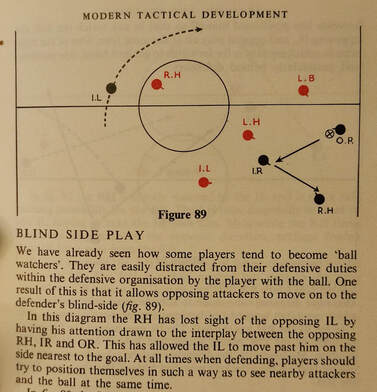
The picture below is taken from the book (p.95) and is one of the numerous illustrations which the author uses to explain the key tactical considerations. This diagram focuses on Blind Side Play.
The picture below is taken from the book (p.95) and is one of the numerous illustrations which the author uses to explain the key tactical considerations. This diagram focuses on Blind Side Play.
In Chapter 4, Wade suggests questions that can be used to provide an analysis of the game, identify strengths and weaknesses, so as to understand what is happening and anticipate how it could develop.
The second section of the book considers the application of sports physiology in terms of training plans for fitness, endurance and speed, strength and power. Wade suggests that training follows what we would now describe as a games-based approach.
Chapters 9 and 10 forms the third part of the book, with discussions on skill and coaching and teaching. Skill is defined as "the application of techniques in a situation where the player has co-operative possibilities and, at the same time, is opposed by one or more players" (p. 181). The chapter reinforces the games-based approach that players need to experience and understand the reasons for particular aspects of game play, not just how they are achieved.
Wade’s philosophy here is that coaching football skills, such as heading or dribbling, by reducing them to their component parts for repetitive practice has deficiencies.
“Repetition for the sake of repetition may only be of limited value”. (p.184)
As co-operative play is integral to the game of football the need to make decisions will arise, any practice sessions must provide opportunities for a player to improve their skills in making such decisions.
The second section of the book considers the application of sports physiology in terms of training plans for fitness, endurance and speed, strength and power. Wade suggests that training follows what we would now describe as a games-based approach.
- Match Practice – providing opportunities to develop systems of play and tactical awareness
- Small-sided games – to develop general principles of play and group tactical possibilities
- Functional training: phase practice - developing understanding between small groups of players
- Tactical practice - developing set plays in various phases of the game
Chapters 9 and 10 forms the third part of the book, with discussions on skill and coaching and teaching. Skill is defined as "the application of techniques in a situation where the player has co-operative possibilities and, at the same time, is opposed by one or more players" (p. 181). The chapter reinforces the games-based approach that players need to experience and understand the reasons for particular aspects of game play, not just how they are achieved.
Wade’s philosophy here is that coaching football skills, such as heading or dribbling, by reducing them to their component parts for repetitive practice has deficiencies.
“Repetition for the sake of repetition may only be of limited value”. (p.184)
As co-operative play is integral to the game of football the need to make decisions will arise, any practice sessions must provide opportunities for a player to improve their skills in making such decisions.
Worthington- Teaching Soccer Skill (1974)
Eric Worthington's Teaching Soccer Skill added to the coaching literature a clear description of how and why to use small-sided games to teach game skills. Chapter 3 is a great read for any coach or teacher of an invasion game. In this chapter, Worthington sets out his coaching approach called Principles of Play. He asserted that, "with a practical understanding of the principles of play it is again a normal feature for such players to be able to fit into any system of play or formation" (p. 54). For this reason, Worthington proposed the use of small-sided games and the Principles of Play approach especially for young players.
The following principles of play are contained in the approach:
Although some illustrations of practice sessions in the book look somewhat "traditional", progressing from warm-up to skill practice to games, Worthington suggested that "initially, the coach should do no more than organise the players to play" (p. 160). This led into one of the key coaching tenets of the text, Realism - "To effect the best transfer from what is done in training session, practices should be used which are similar to those that players face in the game...the more realistic a practice the better the transfer will be" (p. 161).
Another of the pedagogical tenets of the Principles of Play approach is the concept of "Freeze replay". This is where "the players must stop precisely where they are at the time the coach demands that they stop" (p. 172). The coach the uses this real situation as a "living tactical board to show the players what they are doing" (p. 172). The way Worthington described the use of this pedagogy, the coach goes into observation of the game play knowing what game moment they are looking for, as they have decided going into practice what point they wish to develop with the players.
In Chapter 7, Worthington sets out a continuum from "artificial" and "part" to "real" and "whole" game skill practice, which we suggest is a useful reference when thinking about the purpose of an activity when coaching.
Eric Worthington's Teaching Soccer Skill added to the coaching literature a clear description of how and why to use small-sided games to teach game skills. Chapter 3 is a great read for any coach or teacher of an invasion game. In this chapter, Worthington sets out his coaching approach called Principles of Play. He asserted that, "with a practical understanding of the principles of play it is again a normal feature for such players to be able to fit into any system of play or formation" (p. 54). For this reason, Worthington proposed the use of small-sided games and the Principles of Play approach especially for young players.
The following principles of play are contained in the approach:
- Delay in defence: first defender
- Depth in defence: second defender
- Concentration and balance in defence: the third defender
- Depth and width in attack: the second attacker
- Penetration in attack: the first attacker
- Mobility in attack: the third attacker
Although some illustrations of practice sessions in the book look somewhat "traditional", progressing from warm-up to skill practice to games, Worthington suggested that "initially, the coach should do no more than organise the players to play" (p. 160). This led into one of the key coaching tenets of the text, Realism - "To effect the best transfer from what is done in training session, practices should be used which are similar to those that players face in the game...the more realistic a practice the better the transfer will be" (p. 161).
Another of the pedagogical tenets of the Principles of Play approach is the concept of "Freeze replay". This is where "the players must stop precisely where they are at the time the coach demands that they stop" (p. 172). The coach the uses this real situation as a "living tactical board to show the players what they are doing" (p. 172). The way Worthington described the use of this pedagogy, the coach goes into observation of the game play knowing what game moment they are looking for, as they have decided going into practice what point they wish to develop with the players.
In Chapter 7, Worthington sets out a continuum from "artificial" and "part" to "real" and "whole" game skill practice, which we suggest is a useful reference when thinking about the purpose of an activity when coaching.
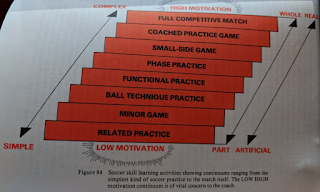
In Chapter 7, Worthington set out an explanation for the purpose of what was called "conditioned games", which are different to games where players are allowed to respond "freely" as the coach deliberately restricts the game to change the condition of practice. It is explained that the conditions of games can be purposefully changed in the following ways:
Teaching Soccer Skill adopts a "non-verses" stance to the instructional style of the coach; however, the "art" of coaching is described as organise, observe, then coach.
Final Thoughts
Throughout this blog, you will have seen similarities between the ideas presented by Wade and Worthington (over 50 years ago) and some of the current sport teaching and coaching literature. It is important to reflect upon early sources of literature to see “what has come before”. For example, this suggested lesson format from 1954 looks similar to the game-practice-game format of the Tactical Games model.
- Vary the number of players
- Change the pitch shape or size
- Change the method of scoring
- Change the laws of the game
- Demand the players respond in a set way during play
Teaching Soccer Skill adopts a "non-verses" stance to the instructional style of the coach; however, the "art" of coaching is described as organise, observe, then coach.
Final Thoughts
Throughout this blog, you will have seen similarities between the ideas presented by Wade and Worthington (over 50 years ago) and some of the current sport teaching and coaching literature. It is important to reflect upon early sources of literature to see “what has come before”. For example, this suggested lesson format from 1954 looks similar to the game-practice-game format of the Tactical Games model.
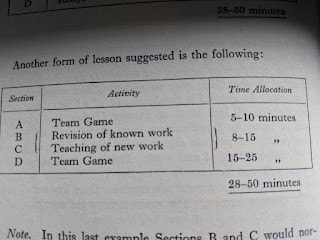
Image from 1954: The Teaching Technique- Playground Games for Secondary Boys, p.6
We would like to encourage you to continue supporting the 40th Anniversary of TGfU celebrations; including our next instalment in the special blogs where we will be discussing Horst Wein: Developing Game Intelligence. Please visit http://www.tgfu.info/40th-anniversary.html for our other events.
We would like to encourage you to continue supporting the 40th Anniversary of TGfU celebrations; including our next instalment in the special blogs where we will be discussing Horst Wein: Developing Game Intelligence. Please visit http://www.tgfu.info/40th-anniversary.html for our other events.
References
Pill, S. (2018) Developing Thinking Players- Coaching Sport for Understanding. Learning Through Sport- Play with Purpose [Blog]. Available from: https://learningthroughsport.blogspot.com/2018/03/coaching-sport-for-understanding.html
Thorpe, R., Bunker, D. and Almond, L. (1986) Rethinking Games Teaching. Loughborough: University of Technology, Loughborough
Wade, A. (1967) The F.A. Guide to Training and Coaching. London: Heinemann.
Williams, L.C. and Willee, A.W. (1954) The Teaching Technique: Playground Games for Secondary Boys. Blackie and Son.
Worthington, E. (1974) Teaching Soccer Skills. Lepus Books.
 RSS Feed